
7 Travertine Plaster Wall Effects: From Modern Minimalist to Aged Mediterranean Stone

Travertine plaster is one of those decorative materials where the final result depends as much on the technique as on the material itself.
Two walls can be created with the same Travertine plaster and look completely different.
One can have deep pores and strong horizontal movement that immediately recalls natural travertine stone. Another can be compressed and polished into a much smoother, more refined architectural surface. A third can be intentionally aged, irregular and dramatic.
That creative freedom is what makes Travertine so interesting.
Instead of choosing one predetermined pattern, the applicator can influence the texture, direction, depth, movement and overall character of the finished wall.
Here are seven popular Travertine effects and some of the techniques that can be used to create them.

1. Classic Horizontal Travertine
This is probably the most recognizable Travertine effect.
Natural travertine often contains horizontal layers, cavities and mineral movement. With decorative plaster, the applicator recreates that visual direction directly on the wall.
The key is not to make the lines too perfect.
Real stone rarely has perfectly straight, evenly spaced horizontal markings. Some lines disappear. Others become deeper. Small cavities interrupt the movement.
That irregularity makes the surface convincing.
The Technique
After the material is applied, the surface is worked while it is still workable.
The applicator develops horizontal movement using the edge or face of a trowel and other appropriate texturing tools. Selected areas can be opened or dragged to create elongated cavities.
Pressure matters.
Too much uniform pressure can make the pattern mechanical. Varying the pressure helps create sections that appear naturally compressed alongside more open areas.
After drying, additional finishing and controlled sanding or polishing can soften overly sharp areas and bring the surface together.
The Result
The finished wall has a strong horizontal architectural direction.
From farther away, it can resemble large sections of vein-cut stone. Up close, the individual pores and handcrafted movement become more visible.
Best for: large feature walls, fireplaces, entryways, hotel lobbies and contemporary living spaces.

2. Open-Pore Natural Stone
Travertine is famous for its pores.
Instead of hiding those imperfections, this effect celebrates them.
The wall contains visible cavities of different shapes and sizes, surrounded by smoother compressed areas.
The most important rule is randomness.
If every pore is approximately the same size and evenly distributed, the surface begins to look manufactured.
Natural-looking Travertine needs quiet areas and active areas.
The Technique
During application, selected portions of the surface are intentionally opened rather than completely compressed.
Tools can be used to create irregular pits, broken cavities and small voids.
Once the surface begins to set, the surrounding material can be compressed while leaving portions of those cavities visible.
The difference between the open areas and the smoother surrounding surface creates depth.
A secondary tonal treatment can further emphasize the effect. Slightly deeper color remaining inside some pores can make the texture considerably more visible.
The Result
This is one of the most tactile Travertine finishes.
Side lighting makes it especially dramatic because every small cavity creates its own shadow.
During the day, sunlight can reveal one character; under evening architectural lighting, the same wall may look significantly deeper.
Best for: feature walls, restaurants, reception areas, Mediterranean interiors and spaces where texture should be clearly visible.

3. Smooth Polished Travertine
Travertine does not always have to be rough.
One of the most sophisticated approaches is to reduce the aggressive texture and concentrate instead on subtle movement, compression and polishing.
This produces a much more contemporary surface.
The wall still has mineral character, but it feels calmer and more refined.
The Technique
The material is applied with less emphasis on deep cavities.
Instead, the applicator develops subtle movement while maintaining a relatively controlled surface.
As the material reaches the appropriate stage, the surface can be progressively compressed with the trowel.
This is where craftsmanship becomes particularly visible.
The applicator is not simply flattening the wall. Different levels of pressure can create subtle tonal and textural variations.
After the appropriate drying stage, controlled sanding and polishing can further refine the surface depending on the desired system and effect.
Raised portions become smoother while subtle movement remains underneath.
The Result
The wall can develop a soft, stone-like sheen rather than looking heavily textured.
Light moves across the polished sections differently, making the finish appear more sophisticated without becoming visually busy.
This effect works beautifully in modern interiors where natural materials are desired but heavy rustic texture would be too dominant.
Best for: modern living rooms, bedrooms, luxury retail, upscale offices and minimalist interiors.

4. Aged Mediterranean Travertine
Here the goal changes completely.
Instead of trying to make the wall clean and contemporary, we intentionally introduce age and character.
Imagine an old Mediterranean villa, a weathered European wall or stone that has existed for generations.
Perfect surfaces are not the objective.
Cracks in movement, irregular cavities, distressed sections and tonal variation become part of the design language.
The Technique
Texture is developed more aggressively.
Some areas can remain relatively flat while others contain deeper movement and irregularities.
The surface should not appear equally distressed everywhere.
That is important.
A convincing aged finish usually needs visual pauses. If every square inch is heavily textured, the wall can become overwhelming.
Layering color can also make a major difference.
A warmer or darker secondary tone can settle into deeper portions of the texture while raised sections remain lighter.
Selected areas can then be softened or polished, creating the impression of a surface that has naturally changed over time.
The Result
The wall feels warm, organic and established.
It works extremely well alongside natural wood, aged metal, stone floors, warm lighting and earthy fabrics.
Best for: Mediterranean interiors, restaurants, wine rooms, villas, rustic-modern homes and hospitality spaces.

5. Large Travertine Block Effect
One of the most impressive techniques is creating the appearance of large architectural stone blocks without actually installing individual blocks of stone.
The entire wall begins as one continuous decorative surface.
Then architectural divisions are introduced into the design.
The Technique
The layout should be planned before the final texture is completed.
Horizontal and vertical divisions can be marked according to the proportions of the wall.
The dimensions matter.
Small repetitive rectangles can easily begin to resemble ordinary tile.
Larger sections create a much more architectural impression.
Texture can continue naturally across the individual sections, or each "block" can receive slightly different movement.
The lines themselves should complement the overall design rather than dominate it.
The Result
From across the room, the wall can give the impression of large-format stone panels or architectural blocks.
Up close, the viewer discovers that the texture is part of a continuous handcrafted decorative finish.
This effect can make an ordinary drywall surface feel substantially more architectural.
Best for: double-height walls, fireplaces, commercial interiors, entry halls and large luxury residential spaces.
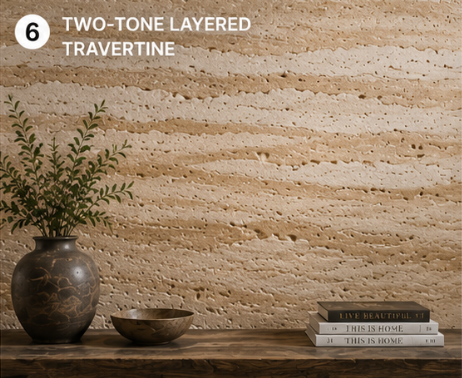
6. Two-Tone Layered Travertine
Color can completely transform Travertine.
A single neutral color can produce a beautiful surface, but introducing a carefully controlled secondary tone can dramatically increase the perception of depth.
The objective is not to paint stripes or obvious patches of different colors.
The colors should interact with the texture.
The Technique
A primary Travertine tone establishes the overall character of the wall.
A second compatible tone can then be introduced selectively depending on the desired effect.
The secondary color may remain more visible inside cavities and textured sections while being reduced on raised areas.
This creates a natural relationship between color and physical depth.
Warm beige with deeper sand tones can produce a classic stone appearance.
Cream with subtle taupe can feel softer and more contemporary.
Deeper brown or earthy tones can create a much more dramatic aged effect.
The transition should remain irregular.
The Result
The surface gains visual dimension even before lighting is considered.
As light moves across the wall, the combination of actual physical texture and tonal variation makes the finish appear significantly deeper.
Best for: dramatic feature walls, restaurants, hospitality spaces, fireplaces and interiors where the wall should become a focal point.

7. Polished Stone With Raw Texture
This may be one of the most interesting effects because it intentionally combines opposites.
Part of the wall remains porous, irregular and visibly handcrafted.
Other portions are compressed and polished.
The viewer sees both the raw texture and the refined surface at the same time.
The Technique
The applicator first creates the overall Travertine movement.
Some areas are intentionally left more open.
Other areas receive additional compression.
As the material reaches the appropriate stage, selected raised portions can be worked more aggressively with the trowel to create a smoother surface.
Further finishing can increase the contrast between the polished sections and the deeper raw texture.
The placement should feel natural.
The goal is not to divide the wall into obvious "polished" and "rough" zones.
Instead, one should gradually transition into the other.
The Result
Lighting becomes especially important.
Smooth compressed sections reflect more light, while deeper textured portions absorb it and create shadows.
That contrast can make the wall appear almost three-dimensional.
From one angle the polished areas may dominate. Move across the room and the deeper texture becomes more visible.
This creates a surface that changes as the viewer moves through the space.
Best for: luxury feature walls, boutique hotels, upscale restaurants, showrooms and statement interiors.

Why Polishing Changes Travertine So Much
Polishing deserves special attention because it does more than simply make the surface smoother.
Compression and polishing can change how light interacts with the material.
A rough surface scatters light in many directions.
A smoother compressed area reflects it more evenly.
Put the two next to each other and the difference becomes immediately visible.
This is why an experienced applicator can create depth without relying only on strong color variation.
Some portions of the wall can remain matte and porous while others become smoother and subtly reflective.
The effect can be especially beautiful with light coming across the wall rather than directly toward it.
The wall begins to react to the architecture around it.
The Trowel Becomes a Design Tool
Travertine is not a material where the applicator simply covers the wall and walks away.
The trowel becomes part of the design process.
Angle changes the movement.
Pressure changes compression.
Direction changes the pattern.
Timing changes how much the material can still be manipulated.
And the decision to stop working an area can be just as important as the decision to continue.
Overworking every section can remove the natural irregularity that makes decorative plaster attractive.
Experienced applicators often allow some imperfections to remain because those imperfections create character.
This is one of the fundamental differences between ordinary wall painting and handcrafted decorative finishes.
With ordinary paint, consistency is usually the objective.
With Travertine, controlled variation is often the objective.
Texture Should Work With the Room
A beautiful sample does not automatically mean the same texture should cover an entire room.
Scale matters.
A heavily textured 2 × 2 foot sample may look fantastic. Applied across a 30-foot wall, the same intensity could become visually overwhelming.
That is why the architecture should influence the technique.
Large walls can often support broader, calmer movement.
Small feature areas can tolerate stronger texture.
A fireplace may benefit from pronounced stone character.
A bedroom may call for something much softer.
A commercial reception area may need texture dramatic enough to remain visible from a distance.
The best Travertine effect is therefore not necessarily the most complicated one.
It is the one that fits the space.
Lighting Should Be Considered Before the Wall Is Finished
Decorative texture and lighting should be designed together whenever possible.
A wall washer or directional ceiling light can reveal texture that almost disappears under flat frontal lighting.
Natural light from a nearby window can create a similar effect.
Before deciding that a texture needs to become deeper or more dramatic, it is worth considering how the finished wall will actually be illuminated.
Sometimes the right lighting can produce more visual depth than adding additional texture.
This is particularly important with polished Travertine.
The combination of smoother compressed sections, raw porous areas and directional light can create dramatic changes across the same surface.
One Material, Many Different Walls
That is ultimately what makes Travertine such an interesting decorative material.
There is no single "Travertine look."
It can be:
smooth or heavily textured, polished or raw, contemporary or aged, subtle or dramatic, monochromatic or layered, seamless or divided into architectural blocks.
The material provides the foundation.
The technique determines the character.
And the interaction between the applicator, texture, color, polishing and lighting determines the final result.
With Travertine by Silk Plaster, the objective is not simply to cover a wall.
It is to create a decorative architectural surface with its own movement, texture and personality, where a plain wall becomes part of the design itself.

